The Care Binder: Everything You Need to Know About Your Aging Parent — In One Place

I'll never forget the morning I found my father having a grand mal seizure and stroke. What came next — new medications, new specialists, mounting appointments — felt like more than I could handle. I needed a way to get some control back. That's when I built the Care Binder. The first time I opened it before an appointment and realized I had everything, I felt something I hadn't felt in months. Like I could breathe again.
By CaregiverPaths.com
Estimated read time: 8 minutes | Free download included
I found my father on the bathroom floor while he was having a grand mal seizure and stroke. Hands shaking, waiting for the ambulance, I could still give the paramedics exactly what they needed — because his medications were easy enough to remember at the time. Two prescriptions and a calcium antacid. Simple.
What came next was not simple. Several new medications—names I had to write down just to say correctly. A neurologist. A cardiologist. A physical therapist. An occupational therapist. A primary care physician who wanted a full update after every specialist visit. It felt like everything was slipping just beyond my reach, and I needed a way to get some control back—not just for his sake, but for mine.
So I started organizing. Everything we needed for appointments went into one place — medications, doctors, visit notes, upcoming appointments. That became my dad’s Care Binder. And the first time I opened it before an appointment and realized I had everything — every medication name spelled correctly, every doctor’s number, every question we needed to ask — I felt something I hadn’t felt in months. Like I could breathe again. Like I was on top of it instead of drowning in it.
It worked so well I made one for my mom too. Now my sister and I can take either parent to any appointment and have everything we need right there, without having to call each other in a panic first.
“The first time I opened it before an appointment and realized I had everything, I felt something I hadn’t felt in months. Like I could breathe again.”
I’m sharing this not because I invented it—I know I didn’t—but because so many of us don’t realize how much we need it until we’re in the middle of everything.
If you’re managing a parent’s care—whether you’re in a crisis or trying to stay ahead of one—this is for you.
Below, I’ll walk you through exactly how to create your own Care Binder: what to include, the supplies that make it simple to maintain, and how to actually use it day to day. I’ve also included a downloadable template at the bottom so you can get started right away.
What Is a Care Binder?
A Care Binder is a physical (or digital) notebook that centralizes all the important details about your aging parent’s health, legal situation, daily care needs, and more. Think of it as a command center for caregiving.
It’s designed to be used by:
Adult children managing a parent’s care from near or far
Family caregivers who want to stay organized
Anyone who wants to be prepared before a health crisis occurs
The binder isn’t just for emergencies. It helps your whole family stay on the same page, makes transitions between doctors and care settings smoother, and gives your parent(s) a voice in their own care — even when they can’t speak for themselves.
What You Need to Build Your Care Binder
Before we get into what to put inside, let’s talk about the physical setup. You don’t need anything fancy — just a few basic supplies that will keep everything organized and easy to navigate.
The Binder Itself
Start with a sturdy 3-Ring Binder A 2-inch binder gives you plenty of room to grow. Look for one with a clear overlay on the front and spine so you can slide in a custom cover label. A Zipper Binder is a great all-in-one option if you want something more portable — it holds loose items and cards without anything falling out.
Organizing the Sections
Use Tabbed Dividers to separate each section of the binder. Label them clearly — a Label Maker makes this look clean and professional and is worth it if you’ll be maintaining this binder long term. You can also use Tab Sticker Sets for a quicker solution.
Protecting Important Documents
Slip loose documents like insurance cards, Medicare cards, and photocopied IDs into Clear Sleeve Sheet Protectors. For smaller items like business cards from doctors and specialists, Business Card Holder Pages that fit inside a 3-ring binder are incredibly handy.
Storage Pouch
Add a Binder Pencil Pouch to hold a pen, a small pair of Scissors, and a Mini Stapler so everything you need to update the binder is right there with it.
Marking & Highlighting
Keep a pack of Highlighters inside the binder to mark important information like allergies, emergency contacts, and current medications. Sticky Notes and Page Flag Tabs are great for marking frequently referenced pages or adding quick reminders.
Preserving the Original Documents
The binder should hold copies, not originals. Store original legal documents — like the will, power of attorney, and advance directive — in a Fireproof Document Bag or Fireproof Document Box at home, and note their location in the binder.
Going Digital Too
A physical binder is essential, but a digital backup is equally important — especially for family members who live far away. A Portable Document Scanner like the Fujitsu ScanSnap or Doxie makes it easy to digitize everything and store it in a secure shared folder. You can also save scans to a USB Flash Drive and keep a copy in a safe location.
What to Put in Your Care Binder
Here’s a breakdown of what each section of your Care Binder should include. Our free downloadable template covers all of these — just print, fill in, and add to your binder.
1. Current Information — Full legal name, date of birth, Social Security number location (note where it’s stored, not the number itself), driver’s license, passport info, home address, phone numbers, and email.
2. Insurance & Benefits — Health insurance, Medicare/Medicaid, supplemental (Medigap) insurance, Part D prescription drug plan, long-term care insurance, and life insurance — all in one place. Be sure to include their preferred hospital and address.
3. Providers — Primary care physician, specialists (cardiologist, neurologist, etc.), pharmacy details.
3. Medical History — A running log of past surgeries, hospitalizations, major procedures, and their outcomes. Current diagnoses, known allergies with reactions, and a full medication log including dosage, frequency, and prescribing doctor. Current symptoms dates and details of when they started. This is invaluable when seeing a new doctor or specialist.
4. Visit Notes — Space to record what was discussed at each doctor visit — findings, medication changes, instructions given, and follow-up needed. Keeping this record helps you track changes over time and advocate more effectively.
5. Referrals — A log for every specialist referral: who made it, who it was to, the reason, whether an appointment was scheduled, and the outcome. Referrals fall through the cracks more than you’d think.
6. Appointments — A running log of every scheduled appointment — date, time, provider, location, reason for the visit, and any prep notes. Before leaving any appointment, log the next one right then and there. This single habit will save you from missed follow-ups and scrambled schedules.
7. Daily Care & Routines — Daily schedule, dietary needs, mobility aids, cognitive or communication needs, and home care provider details. This section is especially important if multiple family members share caregiving duties.
8. Legal Documents — Note the location of the will, trust, power of attorney, healthcare proxy, advance directive/living will, and any DNR order. Include the attorney’s contact information.
9. Emergency Contacts — At least three trusted contacts with name, relationship, phone numbers, and email. Include a local neighbor or friend who can respond quickly in person.
10. Preferences & Wishes — Preferred hospital, religious or cultural care preferences, and a plain-language summary of end-of-life wishes (referencing the full advance directive for legal specifics).
Tip: Involve your parent(s) in filling out the binder if at all possible. It honors their dignity, ensures accuracy, and opens important conversations while there’s still time to have them.
Physical vs. Digital: Which Is Right for You?
The short answer: both.
A physical binder is accessible without technology, easy to hand to a first responder or hospital staff, and doesn’t require a password in an emergency. It should live somewhere visible and accessible in your parent’s home — not locked in a drawer.
A digital backup ensures that other family members — especially those who live far away — can access the information when needed. Store your digital version in a secure shared folder (Google Drive, Dropbox, or iCloud) and share access with at least one trusted sibling or family member.
Use a Portable Document Scanner to digitize everything in the binder. Even a smartphone scanning app works in a pinch, but a dedicated scanner produces cleaner results for legal and medical documents.
How to Get Started (Step by Step)
Step 1: Download the Care Binder template — Use the link at the bottom of this page. Print it out and have it ready before you gather anything.
Step 2: Gather your supplies — Pick up a binder, dividers, sheet protectors, and a pencil pouch. See the supply list above for specific recommendations.
Step 3: Set aside 1–2 hours — Block time when you won’t be interrupted. Have your parent(s) present if possible.
Step 4: Work through each section — Don’t worry about filling everything in perfectly on the first pass. Getting something down is better than waiting for complete information.
Step 5: Store it somewhere accessible — The binder does no good locked away. Keep it somewhere easy to find — a kitchen counter, a bedside table, or a dedicated shelf.
Step 6: Tell someone where it is — At least one other trusted family member or neighbor should know exactly where the binder lives.
Step 7: Review it once a year — Set a reminder to update the binder annually, or after any major health event, new diagnosis, or change in legal documents.
Tips for Long-Distance Caregivers
Managing a parent’s care from another city — or another state — adds a layer of complexity that the Care Binder can help with significantly. Here’s how to make it work from a distance:
Keep a shared digital copy: Use a secure cloud folder that you and a trusted sibling or local contact can both access. Update it whenever the physical binder is updated.
Scan after every doctor visit: Ask your parent or a local caregiver to scan or photograph the Medical Notes page after appointments and upload it to the shared folder.
Schedule an annual review call: Once a year, go through the binder together. Use it as an opportunity to update information and check in on their overall care.
Designate a local point person: Identify one person — a sibling, neighbor, or trusted friend — who knows where the physical binder is and is authorized to use it in an emergency.
Start Your Care Binder Today
The best time to build a Care Binder is before you need it. Not when your parent is in the emergency room. Not when you’re scrambling to find a policy number at midnight. Now, while things are calm and your parent(s) can be part of the process.
It doesn’t have to be perfect on day one. Even a half-filled binder is infinitely more useful than no binder at all. Start with what you know, and add to it over time.
“The Care Binder might be the most important thing you do for your family this year.”
⬇ Download your Care Binder template here and get started today. If this article helped you, please share it with another family caregiver who could use it. It might be exactly what they need.
Care Binder Supplies Quick Reference
Everything you need to set up your Care Binder:
3-Ring Binder (2-inch)
Zipper Binder (all-in-one alternative)
Additional Companion Resources
Extra items that make caregiving flow more smoothly.
Note: As an Amazon Associate, I earn from qualifying purchases. This does not affect my recommendations — I only suggest products I believe are genuinely useful.
CaregiverPaths.com | A free resource for family caregivers
Final Thought
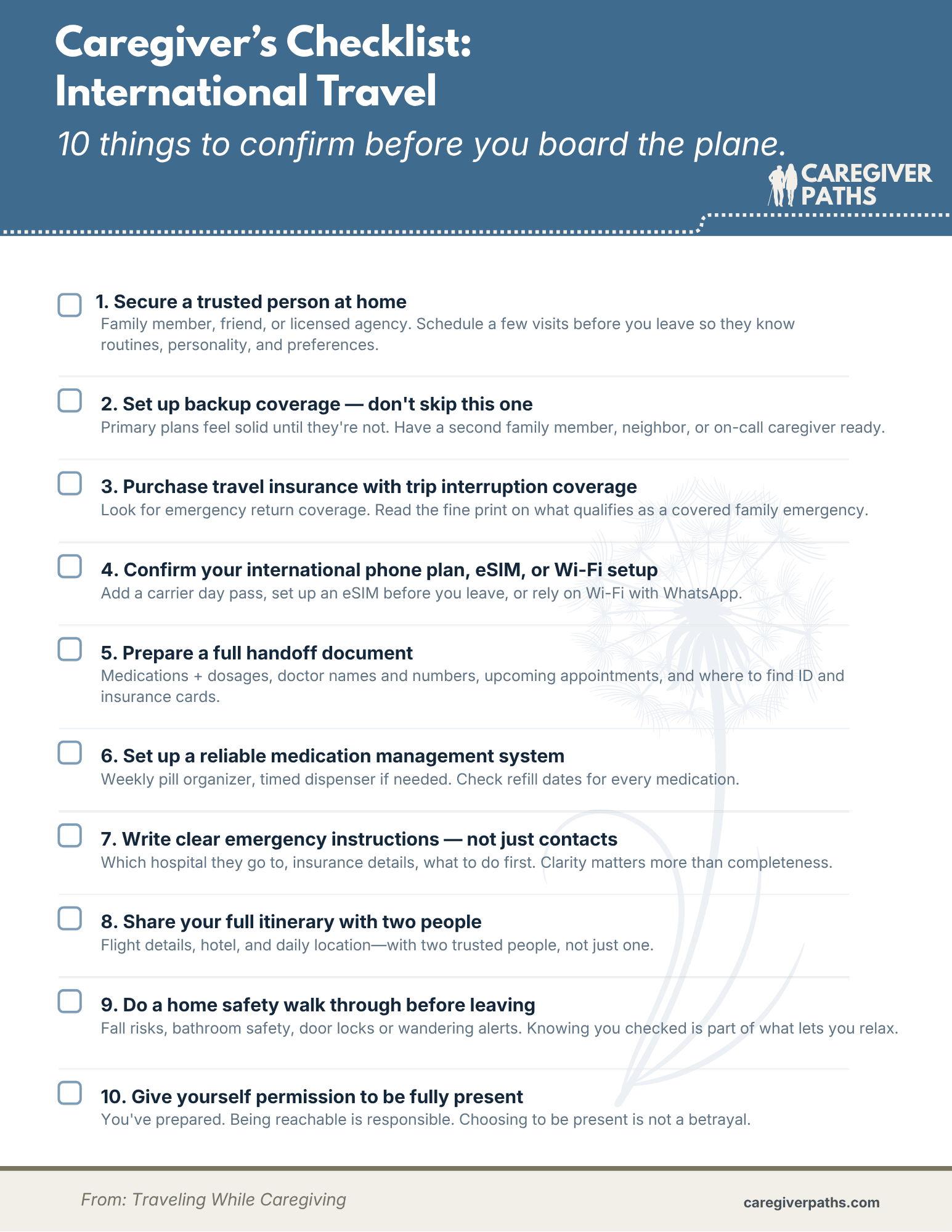
With all of this in place, we walked through Rome — not without responsibility, but without constant worry.
Every person carrying this kind of load deserves that.






Explore Topics






Newsletter
Subscribe now to stay updated with top news!
Subscribe to our newsletter and be the first to access exclusive content and expert insights.
Spotlight

- Sponsored Ad -

Download this check list to help guide you as you begin caring for your aging parent or loved one.